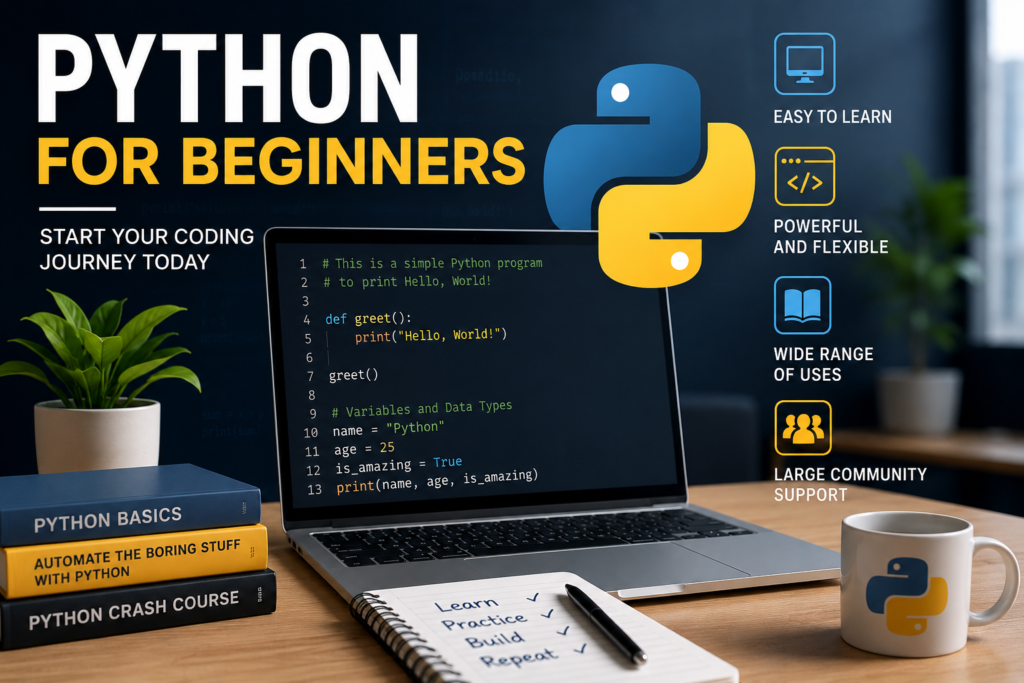
Complete Introduction to Programming python
Python for Beginners: A Complete Introduction to Programming
Python is one of the most popular programming languages in the world. It is known for its simple syntax, easy readability, and powerful capabilities. Whether you want to become a software developer, data analyst, web developer, cybersecurity expert, or AI engineer, Python is an excellent place to start.
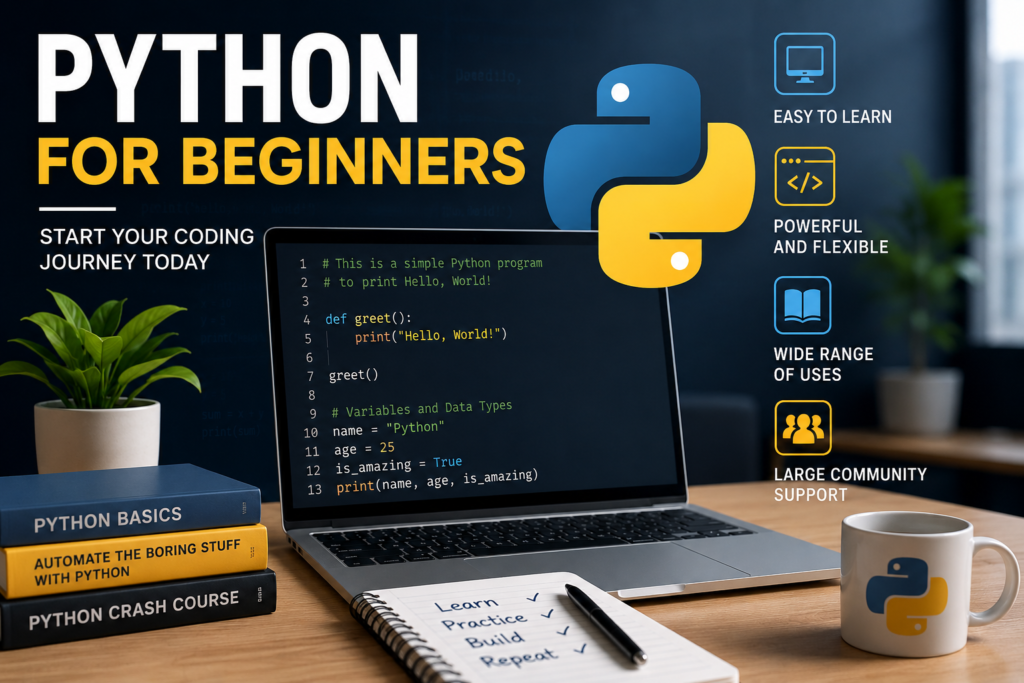
What is Python?
Python is a high-level programming language created by Guido van Rossum and first released in 1991. It was designed to be easy to learn while remaining powerful enough for professional software development.
Today, Python is used by companies such as Google, Microsoft, Netflix, Instagram, Spotify, and many others.
Why Learn Python?
Python is considered one of the best programming languages for beginners because:
- Easy to read and write
- Simple syntax
- Large community support
- Thousands of free learning resources
- Powerful libraries and frameworks
- Used in multiple industries
A beginner can start writing useful programs within a few hours of learning the basics.
Installing Python
To start learning Python:
- Download Python from the official website.
- Install Python on your computer.
- Verify the installation using the command:
python --version
You can write Python code using:
- Visual Studio Code
- PyCharm
- Jupyter Notebook
- IDLE
Your First Python Program
The traditional first program is:
print("Hello, World!")
Output:
Hello, World!
The print() function displays information on the screen.
Variables in Python
Variables store data.
Example:
name = "Ayan"
age = 22

print(name)
print(age)
Output:
Ayan
22
Data Types
Python supports different types of data:
name = "Ayan"      # String
age = 22           # Integer
price = 99.99      # Float
is_student = True  # Boolean
Understanding data types is important because different operations work with different types of data.
Taking User Input
You can get information from users:
name = input("Enter your name: ")

print("Welcome", name)
This makes programs interactive.
Basic Operators
Python supports arithmetic operations:
a = 10
b = 5

print(a + b)
print(a - b)
print(a * b)
print(a / b)
Output:
15
5
50
2.0
Conditional Statements
Conditions allow programs to make decisions.
Example:
age = 18

if age >= 18:
    print("You can vote")
else:
    print("You cannot vote")
Loops
Loops repeat tasks automatically.
For Loop
for i in range(5):
    print(i)
Output:
0
1
2
3
4
While Loop
count = 1

while count <= 5:
    print(count)
    count += 1
Functions
Functions help organize code.
def greet():
    print("Welcome to Python")

greet()
Output:
Welcome to Python
Lists
Lists store multiple values.
fruits = ["Apple", "Banana", "Orange"]

print(fruits)
Output:
['Apple', 'Banana', 'Orange']
Popular Uses of Python
Python is used in many fields:
Web Development
Popular frameworks:
- Django
- Flask
- FastAPI
Artificial Intelligence
Popular libraries:
- TensorFlow
- PyTorch
- Scikit-learn
Data Science
Popular libraries:
- Pandas
- NumPy
- Matplotlib
Cybersecurity
Python is used for:
- Automation
- Security testing
- Log analysis
- Network tools
Automation
Python can automate repetitive tasks such as:
- File management
- Data processing
- Report generation
Common Beginner Mistakes
Avoid these mistakes:
- Forgetting indentation
- Misspelling variable names
- Mixing strings and numbers incorrectly
- Not reading error messages
Errors are a normal part of learning programming.
Learning Path for Beginners
A recommended roadmap:
- Python Basics
- Variables and Data Types
- Conditions and Loops
- Functions
- Lists and Dictionaries
- File Handling
- Object-Oriented Programming
- Projects
- Web Development or AI
- Advanced Python
Conclusion
Python is one of the easiest and most powerful programming languages for beginners. Its simple syntax, large community, and wide range of applications make it an excellent choice for anyone starting their programming journey. By practicing consistently and building small projects, beginners can quickly develop valuable programming skills and open doors to exciting career opportunities in technology.

Stay Updated 🚀
Get the latest tutorials, WordPress tips, AI updates and web development articles delivered directly to your inbox.
💬 Comments
No comments yet
Be the first to share your thoughts.